

an inventory of seamonsters
o writhing ones, evil serpents, encirclers of the world

PART II: an inventory of seamonsters
After writing my friendly seamonster poem, I realized I knew nothing about Leviathian, other than ‘some sort of seamonster mentioned in the Bible’ and Hobbes.1
And so:
Leviathan (from the Hebrew livyatan (לִוְיָתָן), ‘the writhing one’) – alternately referred to as ‘she,’ ‘he,’ and ‘it’ in various texts (I will employ ‘it’ for ease) – is a primordial sea serpent oft used as a metaphor for chaos, anarchy, forces of darkness, an absolute sovereign, addiction, ‘fear itself,’ enemies of state, or simply a real creature.
One commentary noted that at the time the original myth came to be (somewhere around 3500-2000 BCE; perhaps earlier orally) people were casually finding more dinosaur bones and also had no real context for whales or other large sea creatures they might view at sea or find washed ashore. And so the specter of the seamonster loomed large.
I’m in the camp of the seamonster not just being a ‘metaphor for chaos.’ At the time, people were unmetaphorically afraid of creatures they saw at sea or found giant bones of and whose brethren they had every reason to believe still roamed the earth. As with wolves in European fairytales or lions in African folklore, in our current times, wringing our hands about ‘screentime’ and the like, we tend to underestimate the very real terror of being mauled by a wild beast.2
SKY vs. SEA
‘Leviathan’ is an iteration of prior ancient seamonsters, all of whom take part in the great and mythic battle between the storm/sky-god and the sea-god. This story was written in local vernaculars across the Near East, ranging across inner Syria, Egypt, Hatti, Ugarit, Mesopotamia, and Palestine, then emerged into Jewish, Christian, and Muslim texts, and continues to exist in various forms in contemporary popular culture.
I cannot possibly do a full inventory of the world’s seamonsters here (we are many we are mighty), so I will focus on one lineage of Near East seamonster, most emblematically known as LEVIATHAN. The deep-seated vendetta in all these mythologies is SKY/ORDER vs. SEA/CHAOS. It eventually morphs into a BIRD VS. LIZARD thing, but we’ll get there later.
Spoiler: the seamonsters are always defeated by the sky-gods— at least in the myths and holy books as told by the followers of the sky-god.3
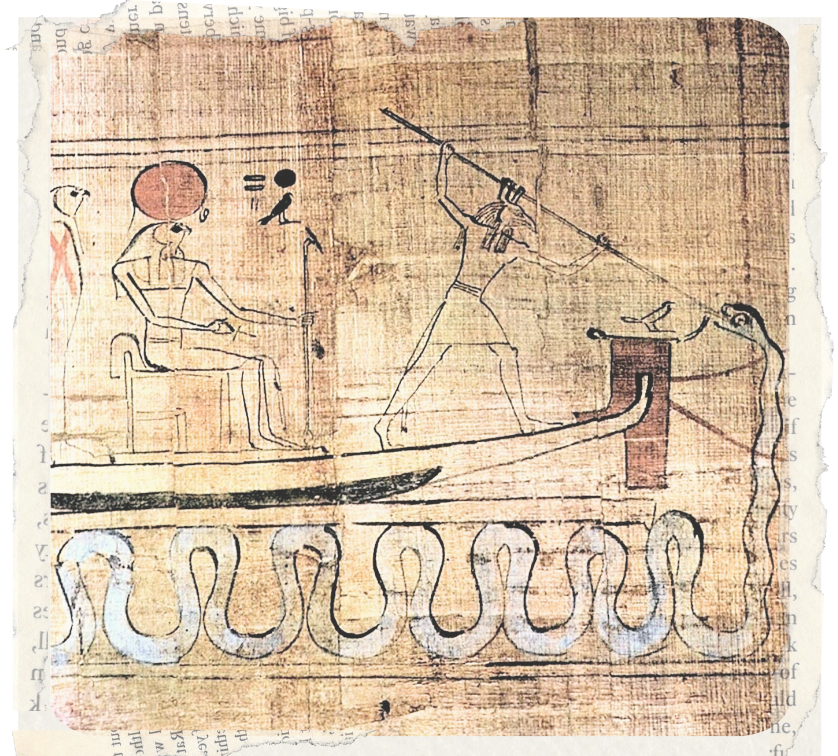
· Apep/Apophis (~2040-1640 BCE): In Egypt, reptile-chaos-darkness-god Apep would nightly attack the sun-barge of sky-order-light-god Ra. Epithets for Apep included ‘the evil lizard,’ ‘the encircler of the world,’ and ‘the enemy.’ While some myths claim the evil lizard was defeated at the hands of storm-god Set and others state that sun-god Ra transformed into a cat (?) and slew Apep, neither method apparently proved effective, for Egyptian priests were perpetually performing elaborate rituals to ward off Apep and encourage Ra in his journey across the sky.
[APEP lives on as a colliding-wind binary star system in the Milky Way galaxy, known as the ‘dragon star,’ and as the Advanced Power and Energy Program (APEP) at UC-Irvine, focusing on power generation and energy conversion.]
· Têmtum (~1800 BCE): serpentine sea-numen in ancient Ugaritic4 mythology, who directly prefigures Lôtān (see below) and subsequently Leviathan; defeated by a sky-god.
[TEMTUM lives on as a cryptocurrency (TEM).]
· Lôtān (1800-1600 BCE): primeval Canaanite monster, described as a sea serpent or a seven-headed dragon, servant of the sea-god Yam. Yam the sea-god fought Baal the sky-god, and Baal was eventually victorious, destroying Lôtān in the process.
· Ḫedammu (1400-1200 BCE): sea-dragon of Hurrian-Hittite5 mythology making mischief off the Syrian coast. Ḫedammu had a ravenous appetite and was considered a grave threat to the storm-god Tarhun (a direct precursor to Zeus). Tarhun sent his sister to stand naked on the shore banging cymbals; the details from here are hazy but suffice it to say that our poor sea-dragon Ḫedammu met his untimely end.
[The victor TARHUN lives on as a popular, carbonated, tarragon-flavored Georgian soft drink.]
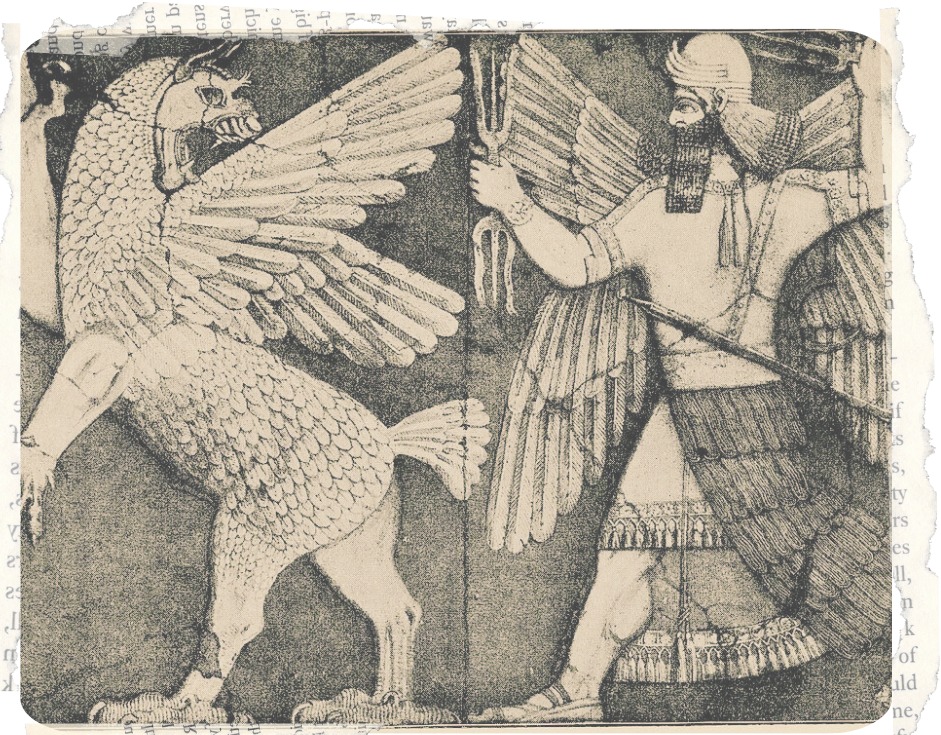
· Tiamat (~1200 BCE): Mesopotamian goddess of the salt sea, mother of the gods and the chaos of creation; often portrayed as a serpent, dragon, or scaled beast.6 Slain by Marduk (Babylonian storm-god); from her body he created the universe.
[TIAMAT lives on as ‘a supremely strong and powerful’ 5-headed draconic goddess in Dungeons & Dragons.]
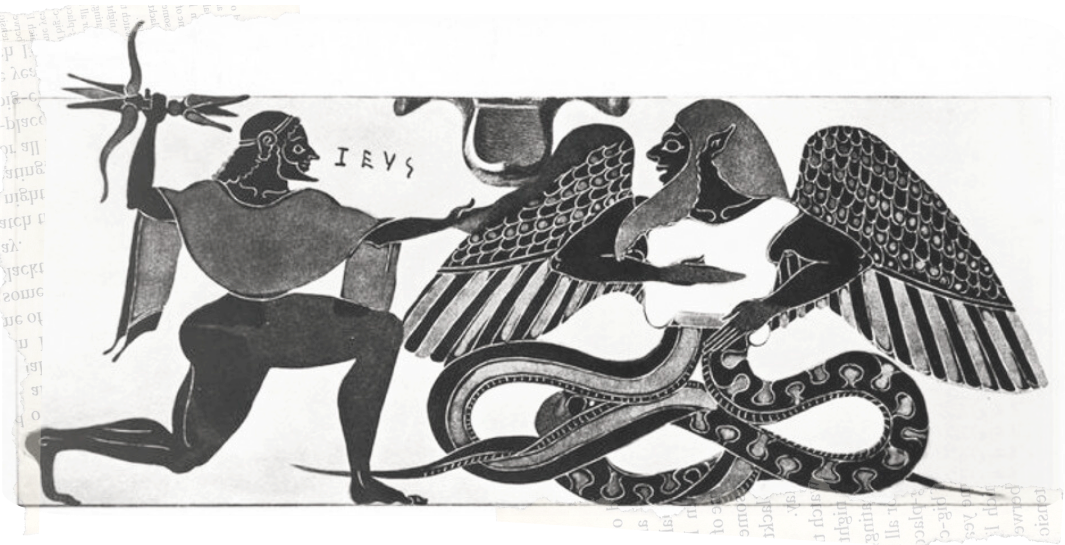
· Typhon (8th c. BCE): The goddess Gaia was furious with Zeus for his poor treatment of her sons the Titans, so she slept with the god of the underworld, Tartarus, and together they produced the serpent-monster Typhon. Zeus (Greek sky-storm god developed from Tarhun/Baal) hurled thunderbolts to kill him, but Typhon coiled himself around Zeus and dragged him into a cave. Zeus eventually prevailed by dropping Mount Etna on Typhon and crushing him.
While we’re in Greece, Hydra (the many-headed water serpent) bears mentioning; she was eventually defeated by hero-demigod Hercules. See the way the myth is being digested and redigested over time, how the story is slowly becoming tired. The compulsion to keep defeating the seamonster even though, ostensibly, it has already been defeated (—or has it?).
By the time we arrive at the Greek pantheon, the fundamental sky-god (Zeus) vs. sea-god (Poseidon) vendetta had mellowed over the past couple of millennia into a complex sibling rivalry; not outright enemies but not really friends either.
TO NOTE:
Again, I have focused only on the Leviathan precursors & the regional reptilian cousins that partake of the same mythological beef (sky vs. sea).
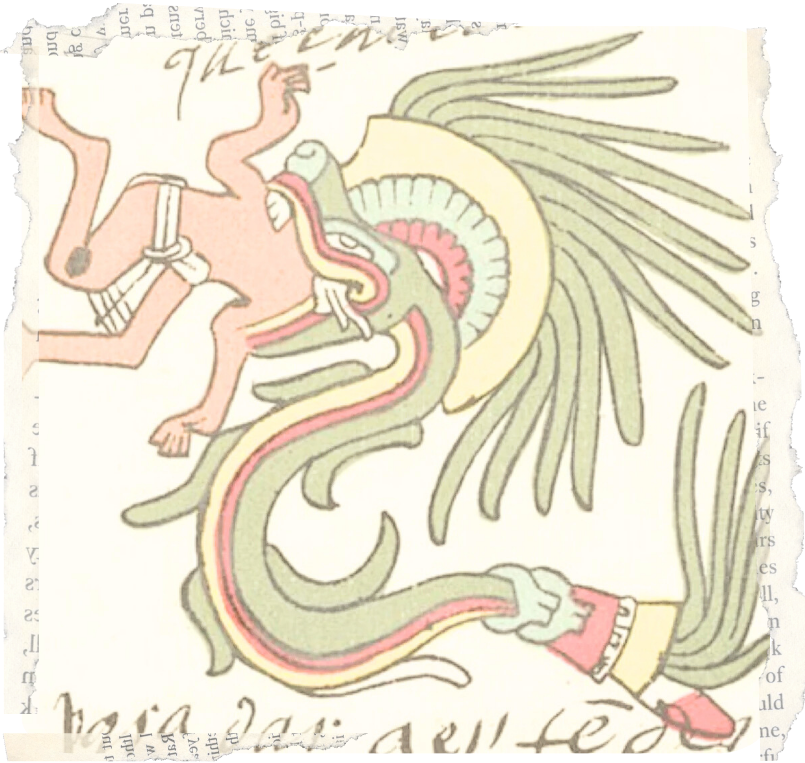
Not all seamonsters have this baggage—witness Yacumama (Quechua for ‘mother of water’) said to be the mother of all marine life; yes, she would vacuum up and devour all nearby life but would also kindly vacate if the locals blew a conch shell to alert her to their presence.
Witness Gunakadeit of Tlingit legend who bequeaths prosperity upon all who behold him.
Witness the Bakunawa of the Philippines, said to devour the moon and summon eclipses, wind, and rain.
Witness the hypnotic, mystical, human-serpents Nāga of Hindu and Buddhist tradition.
And many, many more wonderful marine reptiles spreading joy, wonder, astronomical events, and their own copious meat to coastal villagers. Malign us not.
Hobbes’ Leviathan will not be discussed here. Despite whatever merits of the book, I do think his use of Leviathan is a so-so metaphor and does not do justice to the full range of its seamonsterliness.
Having nearly died at the claws and fangs of a few different wild beasts, I will attest that the death-by-animal terror far exceeds any death-by-human scenario I’ve encountered (also many), a fear so much deeper than anything I have ever experienced, that I can only, stupidly and inadequately, call primordial.
Followers of sea-gods and seamonsters, presumably all marine-dwelling, are not known for their writing (your humble correspondent excluded), so we never get to hear their side of the story. Judging by the millennia through which the sky-god is continually defeating the seamonster over and over again, he is presumably not doing a very good job of killing it.
Ugarit (𐎜𐎂𐎗𐎚) was a port city in northern Syria in existence from 8000-2000 BCE; in its golden age (1500-1200 BCE) it traded with Egypt, Cyprus, the Aegean, Syria, the Hittites, the Levant, and much of the Eastern Mediterranean. The existence of the Ugarit kingdom was discovered completely by accident in 1928 with the Ugaritic texts.
In The Kumarbi Cycle, the Hurrian-Hittite mythology describes the birth of gods and their struggle for power over heaven; this theme of divine succession was appropriated by the Greeks (Hesiod’s Theogony, etc.)
Tiamat’s physical appearance is uncertain; there are only vague descriptions of her in the Enuma elish 𒂊𒉡𒈠𒂊𒇺 (meaning ‘When on High,’ the greatest-ever name of a creation myth)— alternately in the form of a woman and as a body of water and at one point is said to have a tail; later depictions of her trend toward her looking like a dragon or serpent.
The story of seamonsters is always and everywhere a story of the fear of the female (sea) by worshippers of the male (sun).
Great essay, gonna read it some more times.