

how seamonster became satan
it had ten horns and seven heads and on each head a blasphemous name

PART VII: every god needs an adversary
Every god needs an adversary. When you finally kill your adversary, you must find or invent a new one. Without an adversary, you are not a god. You can be a concept (‘the Universe,’ Keter, ‘All One’) but not a god.
The sea-god (Apep/Yam/Tiamat/Poseidon) and the sky-god (Marduk/Baal/Zeus/YHWH) duked it out for millennia. In every telling, the sky-god won. The story was told and retold until finally it got tired. The sea-god all but disappeared.
But every god needs an adversary. If you asked anyone with even a vague grasp of Judeo-Christian worldview, ‘who is God’s adversary?’ they would say ‘Satan.’
Who is this Satan? When did he show up?
possible Zoroastrian origins
Around 6th c. BCE, the Jews return to Jerusalem after Babylonian then Persian conquest, and when they do, they take elements of Persian religion with them—Zoroastrianism, known for its good vs. evil duality. At this time, ‘evil’ starts being attributed to a force other than God. But this is all still rather vague within Judaism, and the evil antipode is not well-developed.
snake in the garden
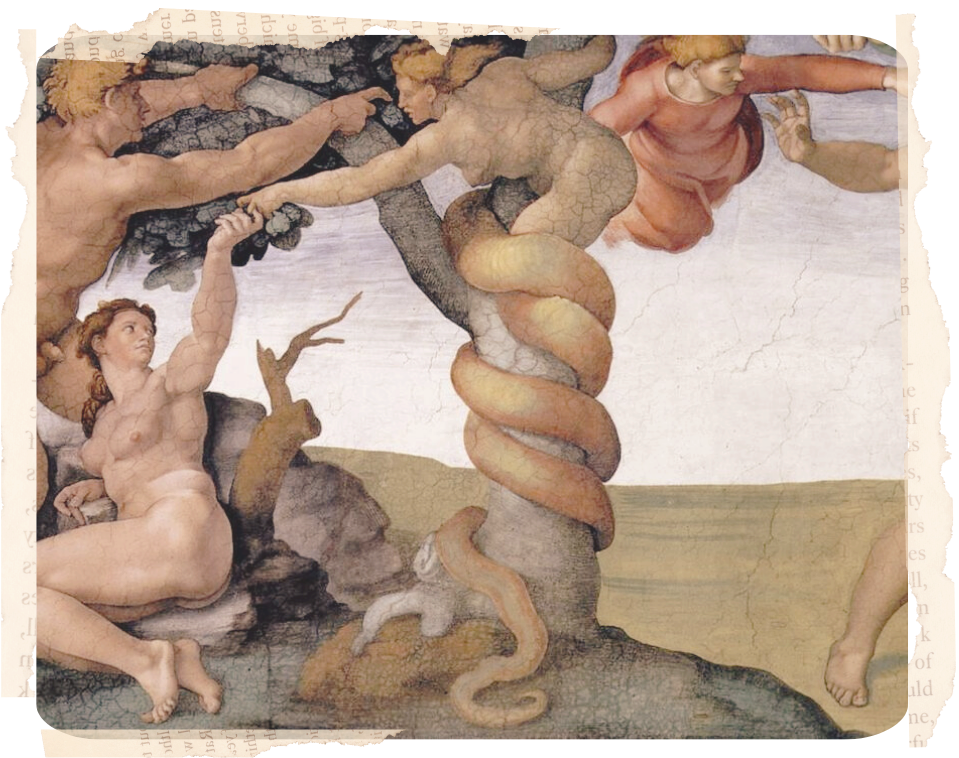
Satan is never mentioned in the Book of Genesis (believed to be written ~5th c. BCE). Later interpretations — once the concept of the Devil was developed in later centuries — conflate the serpent in the Garden of Eden with Satan, but there is nothing in the text itself to support this. All it says in Genesis is ‘serpent.’ God’s Enemy is still a reptile, but is no longer a terrifying looming beast of chaos, just a wily little snake in a tree.
In fact, there is a bit of discomfort theologically with saying that God has an enemy at all. Gone are the days of SKY-GOD vs. SEA-GOD: this implies two elemental forces equal in battle. But our new God is almighty, this is a monotheism dammit, we dispensed with all the idols in the desert and certainly will not be discussing seamonsters. However, every god needs an adversary. So there’s a snake, and soon, a satan.
gambling with God
Satan first formally shows up in the Book of Job (written somewhere between 540-330 BCE) and is referred to as ‘the Accuser’ or ‘the Adversary.’ But he isn’t evil or scary, just a guy that likes to provide a compelling counterpoint. Satan is a former angel booted from heaven for his sins of pride and insolence who now places obstacles in front of humans to challenge them to choose good or evil.1
Satan remarks that wealthy, happy, God-fearing Job would certainly lose his faith if he were to lose his worldly possessions. God takes the bet, and Satan piece by piece strips Job of his family, money, lands, and health. Job, shockingly, does not turn away from his faith, which incites a lot of victorious chest-thumping from God
…including an exceptionally long passage bragging about how he slew Leviathan, proof of his mighty power over all creation. Satan and Seamonster stand awkwardly in the same chapter, not the same character but not-not the same. God is trumpeting about his defeat of one enemy while its new iteration is skulking nearby, leaning against a wall, flicking his lighter.
away with you, Satan!
By the time we get to the New Testament several hundred years later (~70 CE), Satan is more sinister and present than he was is in the Old Testament. Demonic possession is apparently rampant and our new demigod Jesus is an exorcist, removing evil spirits from afflicted bodies. Satan tries to tempt Jesus in the desert; failing to do so, he saunters off, waiting for a better opportunity.
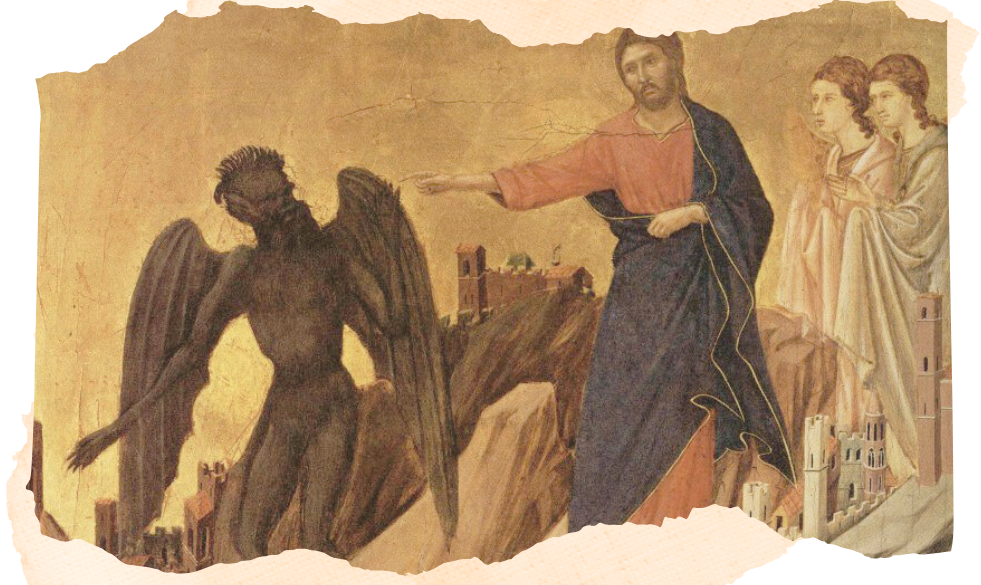
There is an active malevolence now. The transition away from the sea-god and seamonsters seems complete: we are now afraid of the Devil and his demons.
the beast returns!
And then, all of a sudden, in the Book of Revelation (believed to have been written ~95 CE), we suddenly hear about the seamonster again; the endtimes are one final hurrah for God to destroy all his enemies old and new.
And I saw a beast coming out of the sea. It had ten horns and seven heads, with ten crowns on its horns, and on each head a blasphemous name… One of the heads of the beast seemed to have had a fatal wound, but the fatal wound had been healed. The whole world was filled with wonder and followed the beast. (Revelation 13:1-3)
What a nightmare! The sky-god slew the seamonster over and over, boasted about it to his friends, thought He’d finally defeated the beast, but no bad blood stays buried forever, does it. The monster reemerges at Judgment Day, not as salted jerky for the Righteous, but as a many-headed terror, on each head a blasphemous name.2
One of the heads of the beast seemed to have had a fatal wound, but it had healed: the beast cannot be killed. Yes, perhaps we realized this long ago. God certainly has been fretting about it — every time He thinks He’s killed that naughty fish, there it is again. And now, with a vengeance! And now, the whole world is filled with wonder at the sight of the beast and follows it! This is God’s worst nightmare.
And it’s about to get worse. As we all recall, God initially made two monsters – sea-beast Leviathan (whom he tossed into the ocean) and earth-beast Behemoth (whom he cast deep into the desert). Now, after nightmare-Leviathan comes out of the sea, her long lost boyfriend Behemoth emerges from the earth:
Then I saw a second beast, coming out of the earth. It had two horns like a lamb, but it spoke like a dragon. It exercised all the authority of the first beast on its behalf, and made the earth and its inhabitants worship the first beast (Revelation 13:11-12).
Behemoth, a true gent, defers all his beastly authority onto Lady Leviathan. It seems they’re finally going to have their moment.

Alas, this is a book written by the scribes of the Lord. No monster-rom-com nor glorious-vengeance-after-millennia-of-wrongdoing denouement is forthcoming for our star-crossed lovers Leviathan and Behemoth.
Alas, the same story is about to be told again. Down from the sky comes a demigod with his Heaven Bros riding on white horses and dressed in fine linen, white and clean (Revelation 19:14).
And, yes, alas, the story will end as it always does:
He took hold of the dragon, that old snake, who is the Devil, or Satan, and chained him for 1,000 years. The angel threw the devil into the hole without a bottom. He shut it and locked him in it. (Revelation 20:2-3)
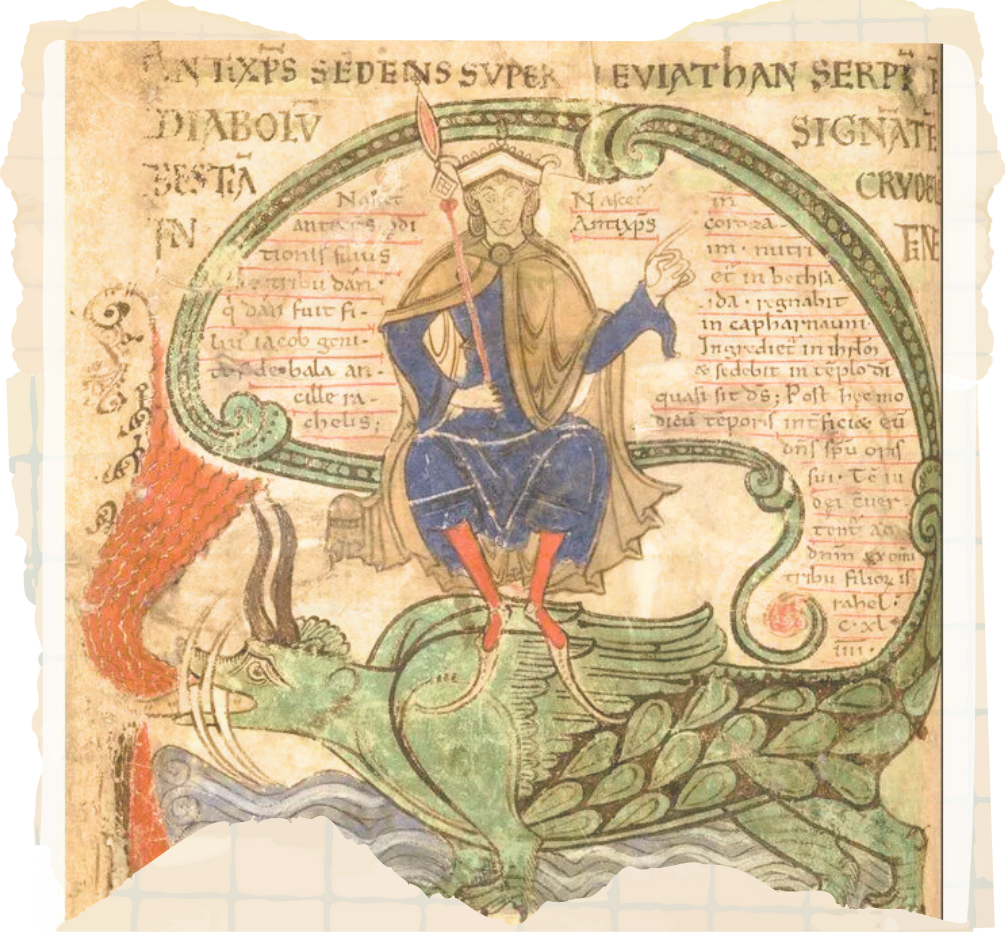
But wait, that was interesting — John the Revelator had a brilliant innovation: the dragon, that old snake, who is the Devil, or Satan. This is the first time the seamonster and Satan are considered to be the same entity.
SEA-GOD = SEAMONSTER = SNAKE IN THE GARDEN OF EDEN = SATAN
We more or less accept the conflation of these characters as a given now, but it evolved piecemeal and uncertainly over centuries and wasn’t cemented until this line.
And with that, the baton is passed: humankind no longer fears giant beasts in the same way we once did. We have cities and governments and laws and are suddenly much more afraid of the evil within ourselves and one another. The Seamonster has ceased to churn the stomach in the way it did in 4000 BCE. Now it is the tempting, clever Satan (tickling our worst impulses, lurching out of our neighbors, lurking anywhere, in anyone) that conjures nightmares.
daimons to demons
Over the next several centuries, Satan tiptoes further and further into the general consciousness.
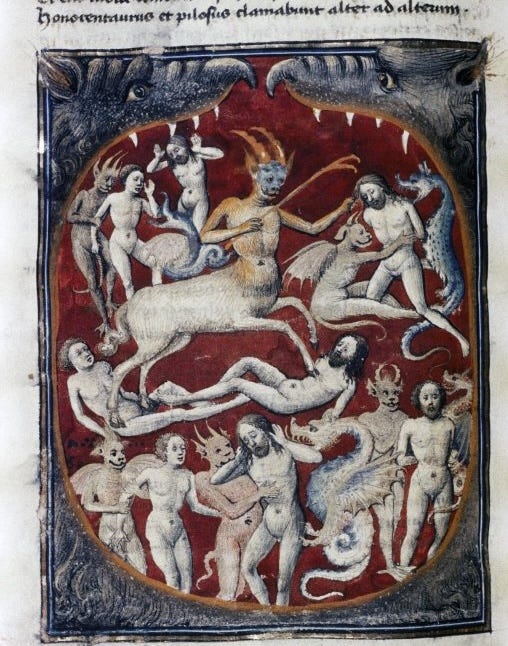
Daimon was an ancient Greek notion of animating spirits that inhabited our world with us, neither good nor evil. In early Greek translations of the Bible, daimon was used to refer to the pagan gods; by the middle ages, daimon had become demon and was exclusively evil. Worse, these wicked horseflies were everywhere and you had to constantly guard against them entering your home or person.
By later medieval times, Satan alternates between a swarm of devils and a singular Devil. Various stories and plays emerge about pacts with the Devil.3 The devil/s are animalistic, horned, beaked, clawed, sexual, lurking in caves and forests; we still see flickers of the terror of the natural world here before it becomes wholly fear-of-other-humans. Satan remains inchoate: he is one he is many he is beast he is man he is brutish he is clever.
St. George & the dragon becomes a popular theme in the 11th-13th centuries, adopted from earlier seamonster-slaying myths (Marduk slaying Tiamat, Perseus slaying Cetus, Zeus slaying Typhon…). The swarms of demons we must guard against and the evil dragons brave knights must kill start to pulse and throb into the same character, and the mythic memory of a giant seamonster splinters into a legion of demons and dragons.
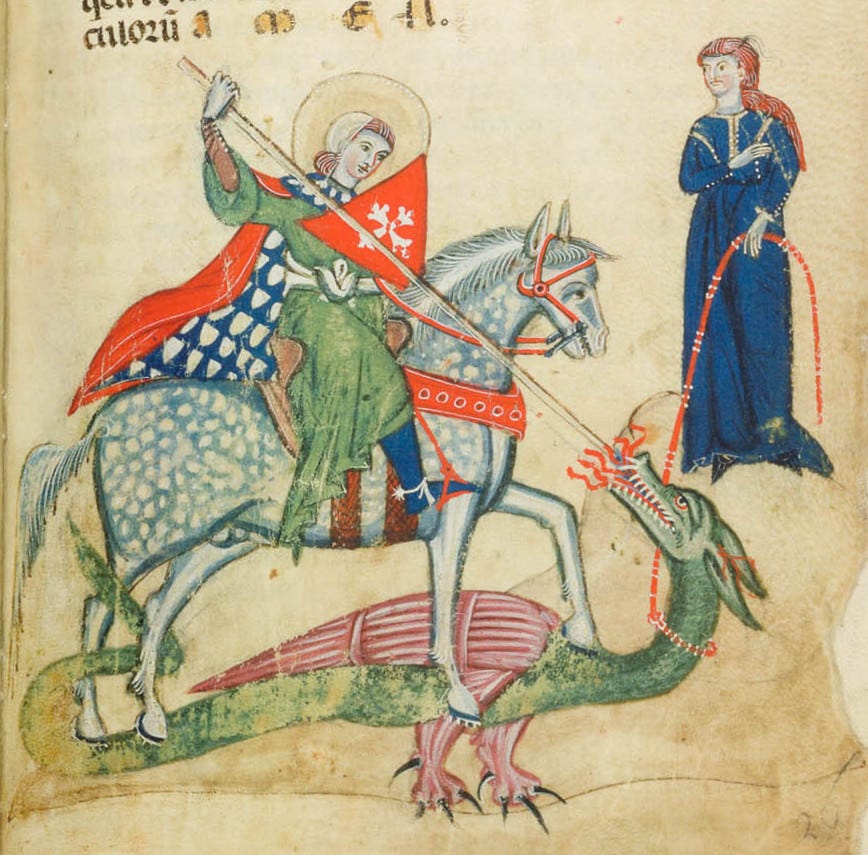
Dante’s Satan in The Inferno (early 14th c.) is modeled after the Qur’anic Shaitan4 and, after God damns him to the inferno, is a miserable lonely batlike blobguy munching eternally on Judas Iscariot & Brutus in a frozen lake. This lake is perhaps the last nod to the seamonsterly origins of Satan.
satan grows up
Satan gradually gathers some steam and style, becomes less of a sadsack, less of an animal, and more of the sexy complex mischief-maker we know today.
As ideas like sorcery and witchcraft come into acute focus, Satan rises in prominence and prestige. Weaving through the Inquisition, witch trials, the Enlightenment, colonization of the New World, invention of electricity, and development of germ theory & vaccines is the violent obsession with sorting the shadowy, mysterious, natural, native, magical, virulent dark from the logical, scientific, Christian, clean bright light. Fear of the devil becomes frenzied, hysterical; he must be rooted out: exorcisms, burnings at the stake, trials for heresy—Satan is powerful but we have the tools to eradicate him.5
By the early modern period, writers were beginning to toy with Satan’s complexity. We see Christopher Marlowe’s Lucifer (Doctor Faustus, 16th c.) as an angel fallen from God’s grace who is now trying to entice and trick as many souls as possible into hell.6 In Milton’s Paradise Lost, the Devil becomes seductively rational, a sympathetic anti-hero.7 In Goethe’s Faust (early 1800s), the Devil doesn’t even do his own dirty work but instead sends his well-heeled & charming concierge Mephistopheles.8
These days the Devil is almost exclusively rich, white, has a beard of some sort, wears a suit, does not seem tortured or to be sad about his estrangement from the Lord and in fact seems to be quite enjoying the enterprise of evil and invites you to do the same.
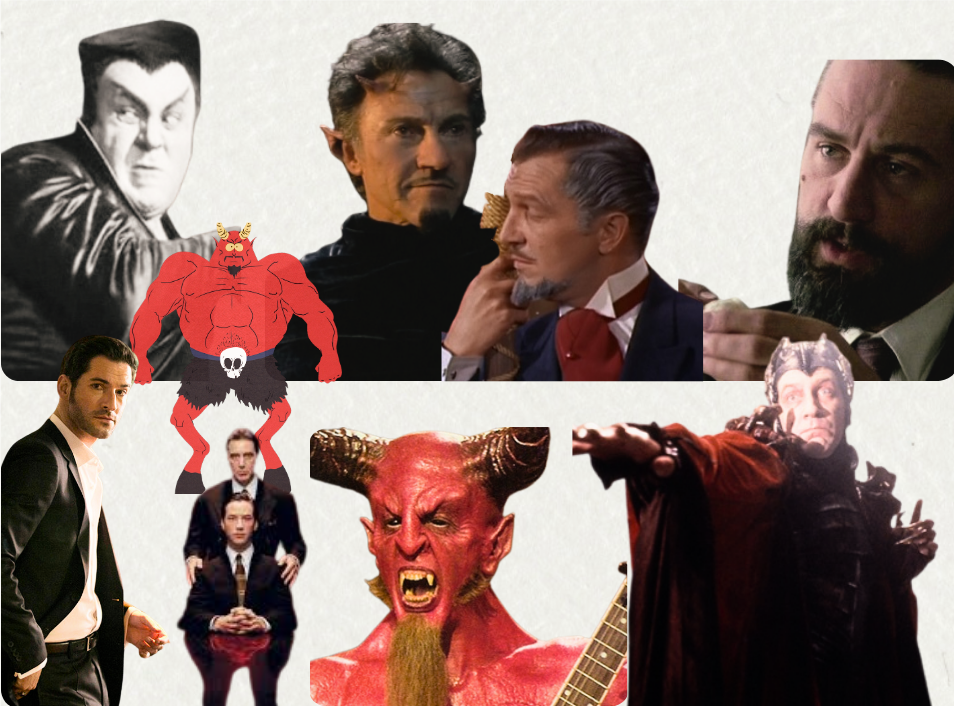
And somehow over the course of millennia, God’s Enemy #1 went from a gigantic terrifying (usually female) seamonster to a well-dressed man with a goatee.
Bit of a downgrade if you ask me— but who we consider to be the enemy or the antithesis of our god reveals what we fear. In the Bronze Age and into the Iron Age, humans feared the terrifying power of nature, which completely controlled their survival, and they mythologized battles between sea and sky. As civilizations became more complex and people moved into cities, the prominent fear was of one’s fellow man and what demons he may hold within.9 But the demonic still was animalistic, legion, moving in and out of living creatures—as plagues tore across the earth and there was no scientific understanding of transmission of disease. As a rational, mechanistic, electric worldview came to the fore, Satan adjusted, becoming more clever, charming, with lively and convincing arguments. Now it seems we fear the glamour, the connections, the world-moving riches of the elite, even as they enthrall us.
And what is the most sinister, shocking invective hurled upon this shadowy cabal of the nepotistic megarich?
‘Reptilians’ of course! In the past 30 or so years, conspiracy theorists have begun to explicitly link elites with the seamonsters and dragons of old. Royalty, politicians, C-suites, celebrities: they are in fact alien reptiles that have been lurking upon the earth since ancient times.
That damn seamonster just WILL NOT DIE.
Within both the Jewish and Islamic traditions, Satan is considered to be a personification of yetzer hara (‘evil inclination’) or waswās (’evil suggestions’) within human beings.
I like to imagine a head for each name of every version of the seamonster the sky-god claimed to have defeated; lo, behold Apep! Temtum! Hedammu! Tiamat! Typhon! Hydra! Cetus!
This story was later developed into the Faust legend and pinned on the historical alchemist and astrologer Johann Georg Faust (1480–1540 CE).
In the Qur’an (610-632 CE), Shaitan is depicted the Angel of Light that refused to bow to Adam. Fiercely loyal to God and refusing to accept the divinity of man, he was cast out of heaven and forever condemned to hell. No good deed goes unpunished eh.
The paradigmatic text for this era being the Malleus Maleficarum (‘Hammer for Witches,’ 1486), which prescribes exorcisms and various tortures for those who consort with the Devil.
‘in hell is all manner of delights’
William Blake famously stated that in Paradise Lost, Milton ‘was of the Devil’s party without knowing it.’
Faust is often interpreted as the anti-Job— what would have happened if Job had not been righteous and steadfast and had instead caved to Satan’s pressure.
Not to mention women! Notorious devil-consorters, witches and temptresses all.
brilliant & hilarious. one of my favorite reads lately!
While reading this I had a great memory from middle school (rare! perhaps there is only this one!) of peeking over at a boy drawing on his paper-bag textbook cover "I LOVE SATIN" and stifling a laugh the entire class imagining him fondling synthetic textiles in ecstatic rapture